Intro
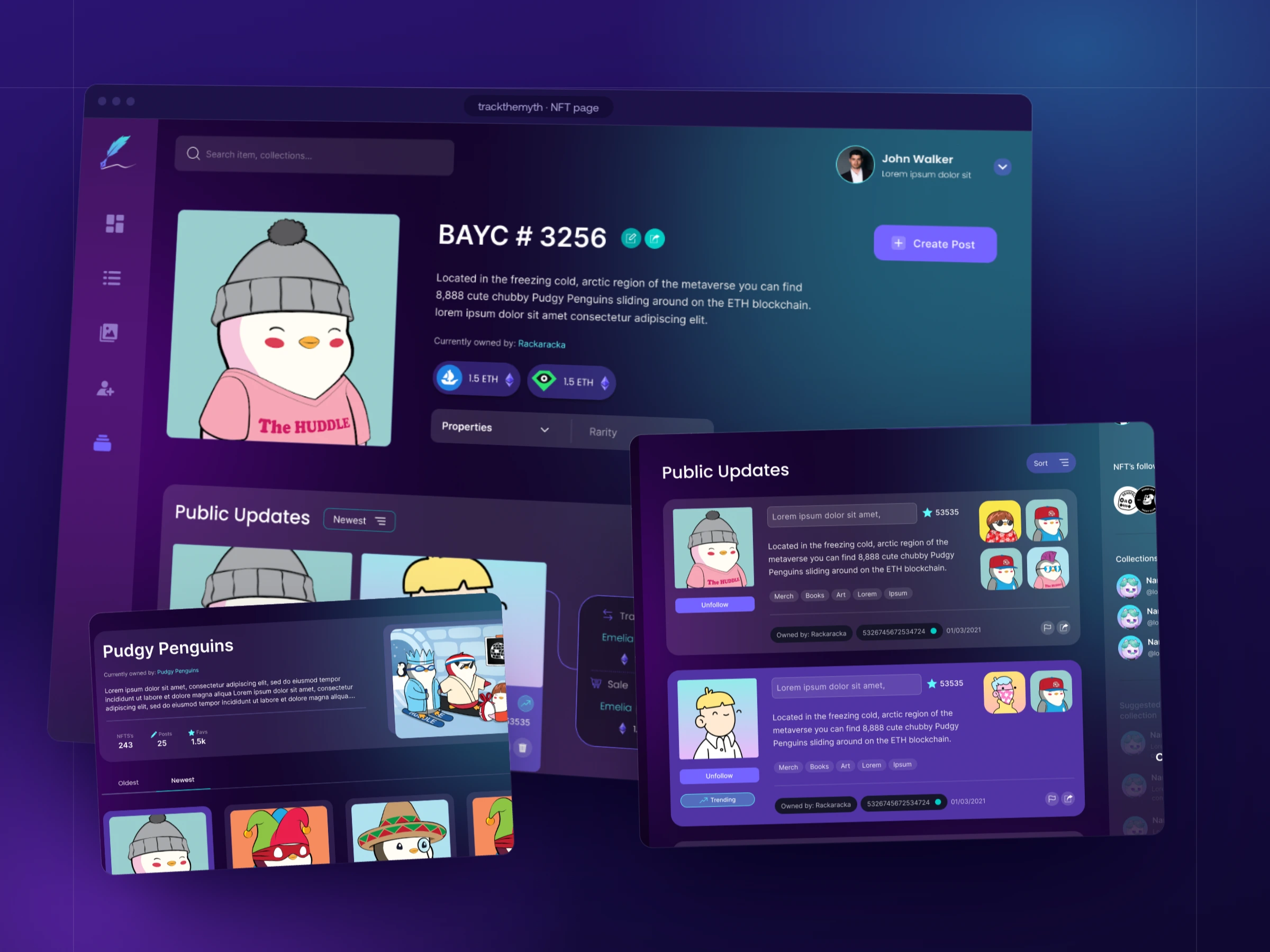
TrackTheMyth pitched itself as Twitter for NFTs. Instead of treating NFTs as items in a marketplace, it treats them as subjects: each one has a page, a story and a feed that its holder can post to and anyone can follow.
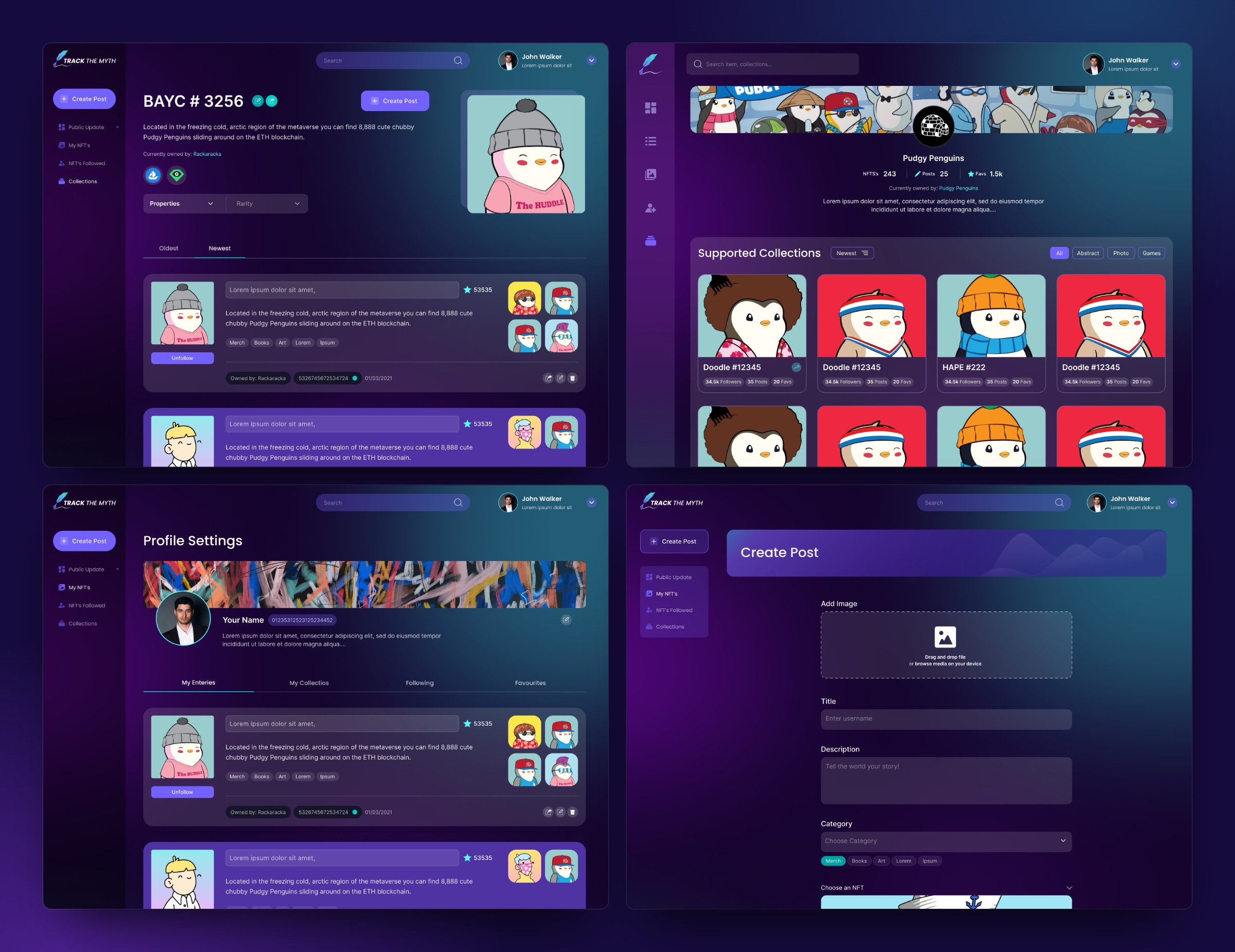
We worked with the team for a few months on the product design — the NFT page, collections, profiles, posting and settings — and iterated the core screens three times as the product sharpened.
What the product design covers:
- An NFT page with owner, value, properties and a feed of public updates
- Collections and supported collections to browse and follow
- Profiles, posting and settings — a full social layer around NFTs
Meet TrackTheMyth
TrackTheMyth was an early-stage team building social tools for NFT communities. Their bet: people collect NFTs for the story and the community as much as for the price — and neither had a proper home.
They needed a product that felt as familiar as a social feed, but was organised around NFTs and collections instead of people.
The challenge we tackled
The object is the NFT
Social apps are built around people. Here the main character is an NFT — with an owner who changes, a value that moves and properties that matter to collectors.
Owner and public views
The same NFT page had to work for its holder, who posts and manages it, and for everyone else, who browses and follows.
Loud artwork, quiet interface
NFT art is bright and busy. The interface had to frame it without competing — dark glass surfaces, one accent colour, consistent cards.
A product still being defined
The team was learning what their users wanted as we designed. The design had to change quickly without starting over.
We have been working with Pace Ventures for a few months and in that time they have been able to execute and deliver on what we are working on as well as providing additional support and insight into creating a great product.
Our approach
01Make the NFT the profile
Every NFT page leads with the art, the current owner, value and properties — then a feed of public updates, like a profile's timeline.
02Two views of one page
“Your NFT” adds the owner's tools — create a post, edit, manage — to the same page everyone else sees in public view.
03Iterate in the open
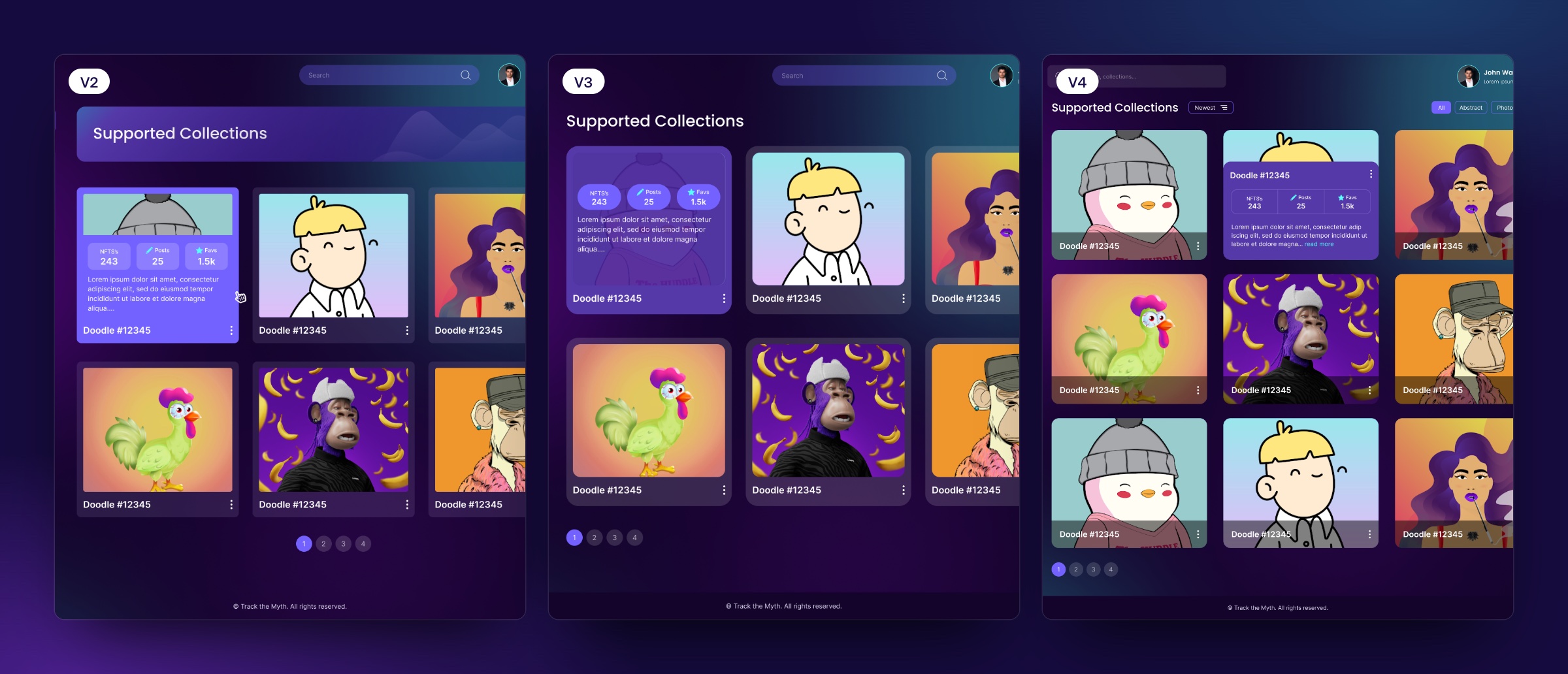
Key screens went through V2, V3 and V4: from a wide sidebar and banners to a compact icon rail, denser grids and filters, as the team learned what users came for.
Social products are built around people. We rebuilt the pattern around an NFT — its page is the profile, its holder is the author, and collectors are the followers.
 Maks MiśkowFounder, Pace LabsPace Labs
Who the product serves
Three groups meet on every NFT page. The design gives each of them a reason to come back.
Holders · followers · collections
NFT holders
A home for their piece: a page, a feed and followers.
Followers
Updates from the NFTs and collections they care about, in one feed.
Collections
A browsable showcase of their NFTs, with holders posting under one roof.
- NFT holders → Followers · Public updates on the NFT's page
- Followers → NFT holders · Follows, likes, attention
- Collections → Followers · Supported collections to browse
- Followers → Collections · Discovery of new pieces
Ownership changes, the page stays: a new holder inherits the NFT's feed and its followers.
Two ways through the app
The same screens, seen by someone who owns an NFT and by someone who follows it.
Holders
Give your NFT a voice
- 1Your NFTOwner view with your tools
- 2Create a postImage, title, description, category
- 3Public updatesYour feed on the NFT's page
- 4Grow followersCollectors follow the piece
Followers
Follow the pieces you love
- 1Supported collectionsBrowse, filter, sort
- 2NFT pageArt, owner, value, properties
- 3FollowThe NFT or its collection
- 4Your feedUpdates from everything you follow
Planning something similar? Let's talk it through.
Maks MiśkowFounder, Pace LabsThe results
TrackTheMyth came out of the engagement with a complete product design — and, in its CEO's words, with products “that can be built upon and scaled in the future”.
- Screen types, from NFT pages to settings
- 8
- Screens in the final design set
- 20
- Design rounds on the core screens
- 3
- Views of every NFT page: owner and public
- 2
- Object at the centre of the product: the NFT
- 1
- Shared component system across all screens
- 1
Summary
The key decision was to treat an NFT like a profile. Once that clicked, the rest — feeds, follows, posting — came from patterns people already know from social apps.
Iterating the same screens three times, fast, let the TrackTheMyth team react to what they were learning without throwing work away.