
Design service

Design that drives conversion, not just looks good

Interfaces that solve real user problems and move business numbers — from research to a product ready for development.

Design that sell

See what's possible when a design has a job to do

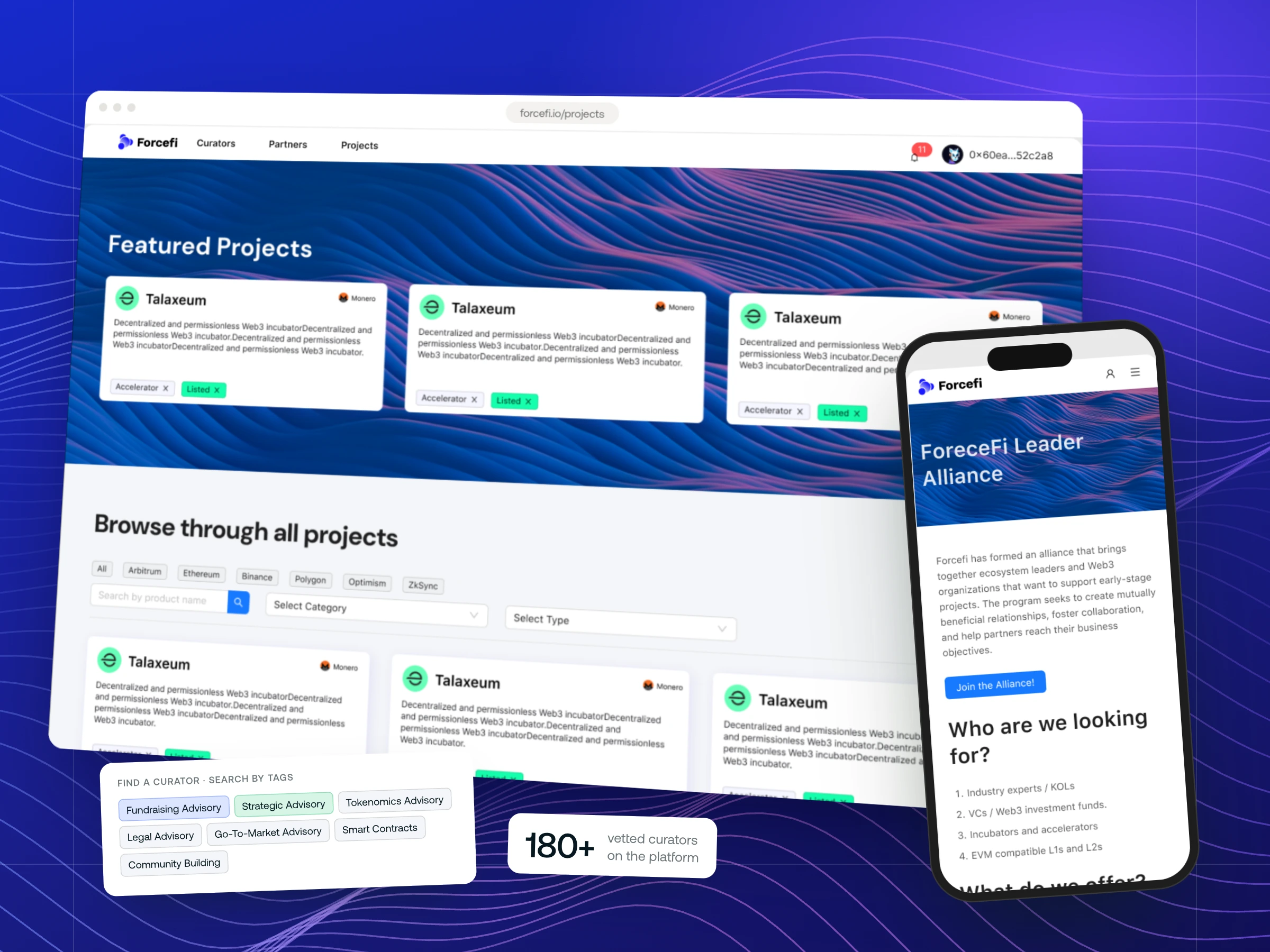
ForceFi project

ForceFi

A launchpad where experts, not gatekeepers, vet the projects

ForceFi is a permissionless launchpad on Arbitrum where independent curators vet early-stage crypto projects and earn when those projects raise. We designed the product for all three sides of that market.

Case study
“We came back to Maks for the second phase because he got the curator model before we'd finished explaining it. Projects, curators and investors all understood the product on the first screen.”

Mikhail SkoblovCEO & Founder, ForceFi180+ curators on the platform

Use cases

Design that power growth

For startups

For startups

MVP interfaces users understand without a manual, prototypes you can test this week, and iterations that keep pace with what you learn.

Result5Concrete deliverables

Why us

Why teams stay with us

Senior team

The people you meet do the work

No hand-off to juniors after the pitch — the team on the first call is the team shipping.

Weekly releases

Working software every Friday

Progress you can click, not status decks. You steer the project every week.

Quality bar

Built to last, not just to launch

Tested, documented and performant — so the next team (or us) can keep building.

Product thinking

We ask why before how

Every feature is checked against the outcome it should move.

Measured

Numbers from day one

Baselines and analytics before launch, so results are provable.

After launch

We stay on

Maintenance, experiments and steady improvements long after go-live.

Process

How we deliver, step by step

A fixed rhythm with a clear output at every step — you always know what's happening and what you'll get.

  1. What happens

    Users, data and business goals before any pixels.

    What you get

    UX audit with prioritised findings

    01Research & workshopsDurationPhase 1
  2. What happens

    Clickable prototypes in front of real users, fast.

    What you get

    Interactive prototypes for real user testing

    02Prototype & testDurationPhase 2
  3. What happens

    Final interfaces built on the validated direction.

    What you get

    High-fidelity interfaces ready for development

    03High-fidelity designDurationPhase 3
  4. What happens

    Design system, specs and support through implementation.

    What you get

    Design system with tokens and components

    04Handover to devDurationPhase 4

Tools we use

The stack behind the speed

The right stack removes bottlenecks — for us while we build, and for your team once it's live.

  • FigmaDesign and prototyping
  • Next.jsReact framework for web and apps
  • TypeScriptTyped code that scales with the team
  • PostgreSQLReliable relational data
  • SanityHeadless CMS
  • DockerReproducible deployments
  • LinearPlanning and weekly releases
  • VercelHosting and previews
  • PlausiblePrivacy-friendly analytics
  • GitHubCode review and CI

In their words

We open new areas faster than most agencies can scope a page. Now a new neighbourhood is a CMS entry, not a project — and it shows up on Google where our customers look.
Roman PeysakhovichCEO & Founder, Cleango

Need more info?

You ask, we answer

The questions we hear most. Anything more specific — ask us directly.

Maks Miśkow

Founder, Pace Labs

Usually replies within one business day

Design deliverables are stack-agnostic, and because we're also engineers, handoff accounts for what your stack can actually build.
Closely — shared design system, specs in their tools, and we stay available through implementation instead of throwing files over the wall.
Both. Audits, redesigns of a single flow, or end-to-end product design — scope matches the problem.
Available for Q4

Let's talk about your product?

Book 15 minutes — bring a screen you're unsure about.

Trusted by